I built automation for ASIC and Westpac.
Now I'm putting it on your
website.
For years, I engineered process systems at Australia's biggest organisations — cutting a 51-step company onboarding down to seven. Then I noticed small businesses missing leads because they couldn't afford the kind of automation those big companies take for granted. So I built Phoenix AI: an AI chat widget that runs locally, stays private, and works 24/7 so you don't have to.
Get in touch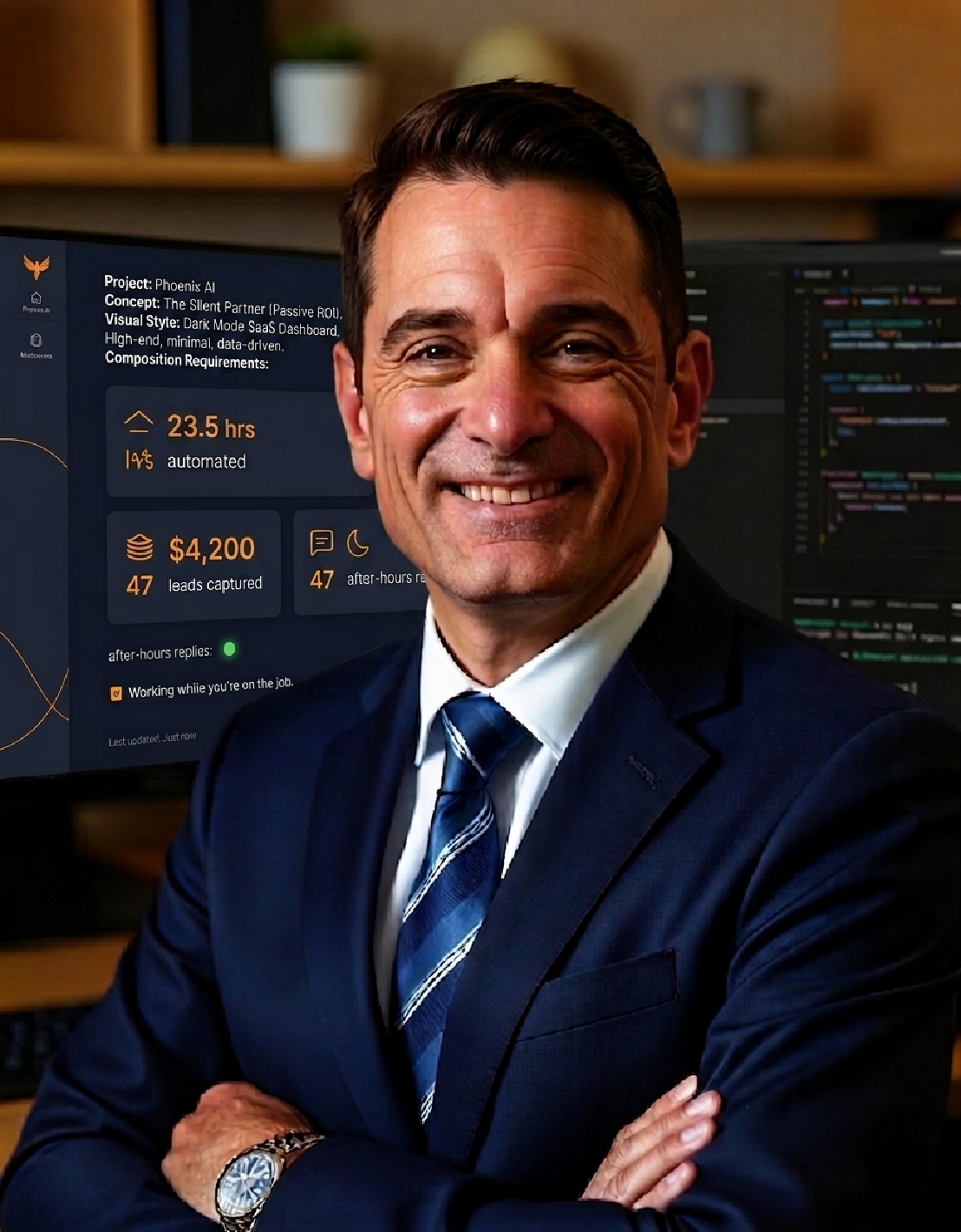
I made automation work for the big end of town. Then I wondered why it didn't exist for everyone else.
The most concrete thing I did at ASIC was take a 51-step company onboarding process and cut it down to seven. Nobody else had sat down and asked if all those steps were necessary. So I did.
I did that kind of work for Westpac, ANZ, CBA, IAG, and others. Enterprise systems. Zero room for error. It was good work, but here's what stuck with me: every time a big organisation wanted to modernise, they had the budget, the teams, and the patience. Meanwhile, the local tradie running his trade from a ute was still fielding phone calls after hours, losing leads because nobody answered.
I thought: if I can automate complex enterprise workflows, why couldn't someone put an AI system on their website that answers questions when they're asleep?
The answer was it's too expensive or too complicated. So I built one myself. Phoenix AI is what happens when you take enterprise-grade automation and strip away everything a small business doesn't need — no API keys, no monthly fees, no data leaving Australia.
PI Agent Harness — Now Available
I've just released the PI Agent Harness bundle — a complete guide to building your local AI agent team. Includes a 440-page ebook, a 6-video series, ready-to-run configs, and all 13 agent definitions. Run a multi-agent AI coding harness entirely on your own hardware. No API costs. Full privacy.
pi-docker — Free Demo
Built in 10 minutes with the PI Agent Harness. Run pi.dev in a fully sandboxed Docker container — isolated from your filesystem, connected to your local model. See what a local AI agent team can ship.
3D Car Scene — Five Agents, One Prompt, 53 Minutes
A 3D parallax car driving through a sunset landscape, built by a 5-agent pipeline on Qwen3.8 27B — then refined iteratively with screenshot feedback, a vision agent, and a debugger. Two geometry bugs caught before a single line was written. Drag to orbit, scroll to zoom. Built entirely on a single RTX 3090.
Aquarium Burst — One Prompt, Full Physics
One prompt to Qwen 3.6 27B: "create a glass aquarium that cracks and bursts." What came back was a complete 3D simulation — water jet following Torricelli's law, fish swimming against the current before getting swept out, glass fragments tumbling with angular velocity, a spreading puddle, and a continuously lowering waterline. Drag the crack to control the jet. Built with the PI Agent Harness pipeline running entirely on a single RTX 3090.
The systems I've actually shipped.
I don't do consulting. I build tools and ship them. Here's what I've put into the world so far:
Phoenix AI Chat Widget
A single script tag embeds an AI chatbot on any website. It reads your site content, answers visitor questions in real-time, and works locally — no API keys or third-party data processing. Built for Australian businesses that want 24/7 customer support without sending their data overseas.
Multi-Agent Orchestration
I've built and tested multi-agent systems running on consumer hardware — single GPUs, not cloud clusters. The idea is simple: each agent handles one job (researching, drafting, verifying), they coordinate through structured prompts, and the whole thing runs under your control. No vendor lock-in.
Local AI Stack on Consumer Hardware
I run production AI workloads on an RTX 3090 — fine-tuning, RAG pipelines, inference. The Local AI Stack Blueprint documents everything I've learned: hardware choices that actually make sense for small teams, models that fit on a single GPU, and the mistakes I made so you don't have to.
The thing I've put my name behind.
Everything else I build feeds into this one product. Phoenix AI is the tool I wish existed when I was still consulting — a way for any Australian business to add 24/7 intelligent customer support without the enterprise price tag or the data-export compromise.
Phoenix AI
The AI chat widget that runs locally, answers your visitors 24/7, and keeps their data in Australia.
PI Agent Harness
Build your local AI agent team — ebook, video series & configs. Zero API costs, full privacy.
pi-docker
Free demo project — built in 10 minutes with the PI Agent Harness. Sandboxed, isolated, fully local.
Notes from the work.
Technical write-ups, lessons learned, and practical guides from real projects.
Building a 3D Car Scene with a Multi-Agent Pipeline
Five agents, one prompt, 53 minutes. A 3D parallax car scene built by a local AI pipeline on Qwen3.8 27B — two geometry bugs caught pre-code, then iterative refinement with a vision agent and debugger. Before/after comparison included.
3D Tetris — One Shot, Full Game
DeepSeek-V4-Flash Q2 one-shot on RTX 3090 — 13.5 tokens/sec, ~30 minutes to generate. Complete 3D Tetris with SRS rotation, ghost piece, hold, scoring, and bloom. No iteration, no fixes, just one generation.
Aquarium Burst — One Prompt, Full Physics
One prompt to Qwen 3.6 27B: "create a glass aquarium that cracks and bursts." Water jet following Torricelli's law, fish swimming against the current, glass fragments with angular velocity, a spreading puddle. Drag the crack to control the jet.
Fine-tuning Devstral-Small-2-24B with Claude Opus Reasoning on an RTX 3090
How I distilled Claude 4.6 Opus chain-of-thought reasoning into a 24B code model on a single consumer GPU — seven bugs, a VLM weight extraction, and a transformers 5.x loading bug that took hours to find.